Becoming a sustainable business has been on most companies’ to-do lists. Some take a long way and implement systems for a more eco-friendly and worker-friendly environment. Some take the easy way by means of greenwashing and inaccurate reporting. In this article, you’ll learn how to recognise sustainable clothing manufacturers.
When you think about how to find sustainable and ethical clothing manufacturers, request the following three things from any potential supplier you get in contact with:
Ethical clothing manufacturers
It goes without saying that to be a sustainable brand, you should only work with ethical clothing manufacturers. At the very least, there must be no child labour or forced labour at your potential supplier’s factory/factories.
The suppliers should be able to prove:
- That they pay a living wage
- That the workers’ health and safety are not in danger at any point during their shifts
Their ethical approach should branch out from the people to the environment. A clothing factory you are assessing should only release wastewater that has passed through a treatment plant. That way, it exits the factory as clean technical water. If they use dangerous chemicals, they must prove that they are storing them safely.
Why do sustainability-related audits and certificates matter?
If clothing suppliers you are considering advertise themselves as sustainable, they should have a way to prove that. Audits and certificates are the easiest way to do so. We believe that sustainability begins with people and for that reason, we decided to do a 4-pillar SMETA social responsibility audit. You can see our results in this report.
As one of the tools to phase out fast fashion from the EU market, transparent and socially responsible supply chain will soon become a legal obligation for the vast majority of companies turning profit in the EU.

Certificates that your customers recognize
Some of the most important certificates are the ones that can prove materials are responsibly sourced and are organic/recycled. Chief among these are the Global Organic Textile Standard GOTS and Global Recycled Standard GRS certificates. We have both. This means that your collection can come with hang tags and inside labels as proof of genuine organic and/or recycled origin.

FUSH˚ license number 017908 Check it here:
https://textileexchange.org/find-certified-company/
We also own three ISO certificates: 9001:2015, 14001:2015, and 45001:2018. Refer to this database to see that our certification is valid.
- 9001:2015 (quality management system) means our organization has put in place effective processes and trained staff to deliver flawless products or services time after time.
- 14001:2015 (environmental management system or EMS) provides us with a framework for designing and implementing an EMS, and continually improving our environmental performance.
- 45001:2018 (occupational health and safety management system or OH&S) provides us with a framework to manage risks and improve OH&S performance.

ISO 14001:2015
Finally, there’s the OEKO-TEX Standard 100 certificate that proves that a piece of garment is free from any harmful chemicals. We are yet to apply for it.
Word of warning, though. If a supplier owns any of these certificates, they’d be able to send you clothing with the labels of those certificates attached to every piece you ordered. Also, you should be able to find them in these databases, before discussing cooperation:
- Global Organic Standard (GOTS) certified suppliers database
- Textile Exchange Database (GRS) certified suppliers database
- OEKO-TEX label check
We’ll expand on this topic in detail in a few scrolls from here.
Insist on transparency
In addition to owning certificates and passing social responsibility audits, a truly sustainable clothing manufacturer should allow you to visit them anytime. In fact, they should encourage it. Being transparent is equally important as owning certificates. With that in mind, we invite you to visit our two factories in Serbia whenever you’d like. We’ve even built and furnished five apartments on one of the factory grounds for that very purpose.
Learn how FUSH˚ achieves sustainability as a clothing manufacturer – read this short pdf infographic.
If you already like what you’ve read and want to request a quote, please keep in mind that our minimum order quantity (MOQ) is 500 pieces per design and/or colour in any size.
Also, you would have to have a registered company with valid VAT and EORI numbers if we are to cooperate.
Learn more about working with us – visit the what we do page.
Key sustainability certificates for fabrics
The sustainability of any clothing brand begins with its supply chain. Therefore, to be considered one, you must work with sustainable clothing suppliers.
The three key certificates for fabrics are:
- GRS
- GOTS
- OEKO-TEX 100
OEKO-TEX 100
This certificate ensures that no toxic chemicals are present in the final product. Learn more about the OEKO-TEX Standard 100.
If you find a clothing factory that has OEKO-TEX 100 certificates for their yarns, trimmings and accessories, dyes, and dye sublimation inks, you’re on the right track. However, in order for you to use the OEKO-TEX label on your brand’s clothing, that manufacturer would have to be certified too and the final product would have to be tested.
Unfortunately, we are yet to enter the certification process for this standard so at the moment, buying clothing from us isn’t going to grant you that your brand can sell OEKO-TEX-certified clothing.
Certificates that guarantee fabrics are organic/recycled
The least you can do as a clothing brand is offer your customers clothes that your manufacturers made from recycled/organic yarns or materials. Global Recycled Standard (GRS) and Global Organic Standard (GOTS) are the most common certificates that prove the origin of fibres is recycled or organic.
GOTS – organic cotton certificate

FUSH˚ license number: 017909
Check it on
https://global-standard.org/find-suppliers-shops-and-inputs/certified-suppliers/database/
If you require sustainable cotton clothing, you should look for GOTS clothing manufacturers. They’re the only ones capable of adding GOTS labels to your organic cotton collections. This is paramount for products like sustainable streetwear should be organic cotton-only (especially custom hoodies and
t-shirts).
*GRS – recycled fabrics certificate
Sportswear/activewear brands still rely on polyester fabric because of its performance during exercise. There is yet to be a natural fibre that outperforms it.
That’s why, if your brand revolves around physical activity, you should only use polyester clothing that a GRS clothing manufacturer makes. Such manufacturer makes collections with GRS labels as proof of genuine recycled origin. And from a CO2 and water consumption standpoint, recycled polyester is so much better than its virgin counterpart. Read more about it in our article about recycled polyester and organic cotton.
Keep in mind that polyester, even when recycled, isn’t a proper sustainable option because it will eventually end up in a landfill or a body of water. All you do is prolong this eventuality by a maximum of around ten years.
It takes centuries for plastic to decompose. Not to mention the issue of microplastics.
If you are to use polyester, we advise you to incentivise your customers to send you back their used clothes. Take it upon yourself to store that textile waste safely.
How do I find a sustainable clothing manufacturer?
If you can’t get to a sustainable clothing manufacturer through your network, you can do so in the following three ways:
- Check relevant databases
- Conduct Google search
- Join sustainable fashion networks
Relevant databases
As we already mentioned, the easiest way to check if a supplier is sustainable is to see what certificates they hold and what audits they’ve passed. From our experience, the most relevant ones are GOTS, GRS, OEKO-TEX, and Sedex.
Google search
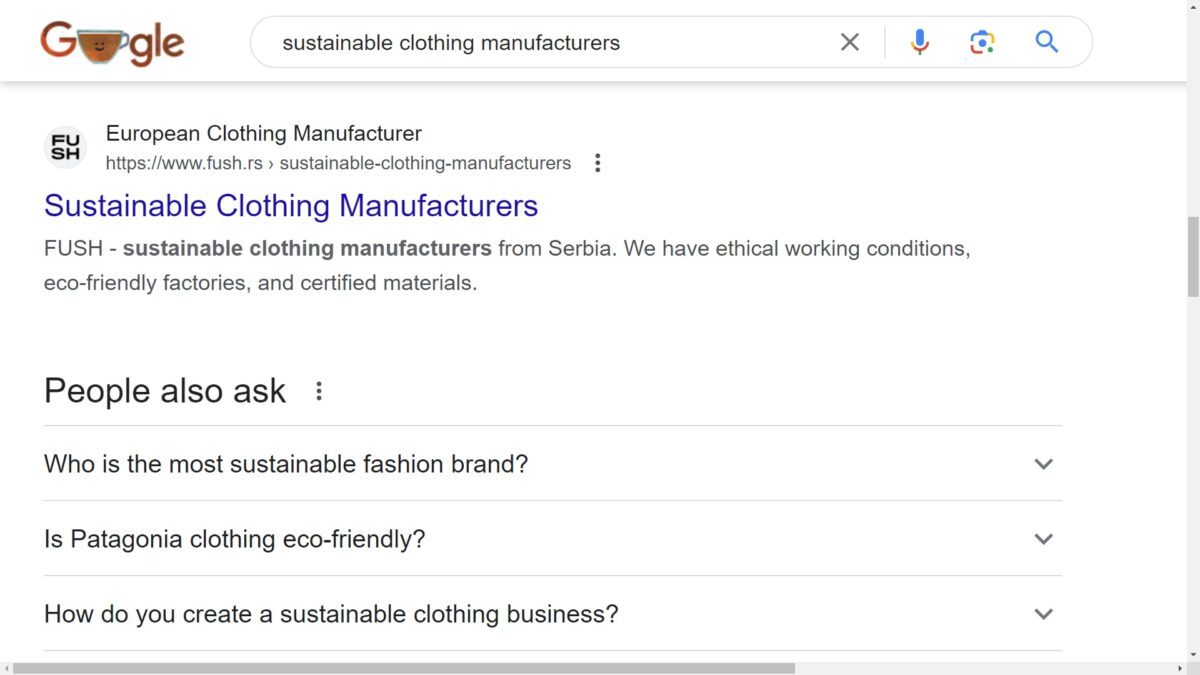
Google search is as good a start as any because this search engine shows increasingly relevant search results with each algorithm update. That’s why there’s a great chance you’ll find sustainable manufacturers this way. Keep an eye on the results with the bolded “Ad” next to the URL – those are sponsored results, often of inferior quality to organic results.
Sustainable networks
There are good sustainable network websites out there too. The two that we find interesting are Manufy and Common Objective. Manufacturer profiles on there are often quite informative, especially in terms of sustainability.
You can also find manufacturer info about decent working conditions, animal-friendly practices, energy and water efficiency, chemical management, pollution reduction, recycling & waste and more. Of course, certified manufacturers will have their certificates uploaded to their profiles.
The next issue to tackle is sustainability when colouring (dyeing or printing) the garments.
Is sublimation printing really that green?
Sublimation printing definitely is an eco-friendly way to apply colour to your clothes. But since it works well only with polyester, it’s not something to associate with a lot of ecological fanfare.
However, the two main reasons for it being eco-friendly are:
- The process uses next to no water (all it takes to transfer a design to a t-shirt this way is around 5 ml of water-based ink)
- It is energy-efficient (two machines that run this process – dye sublimation printers and heat transfer calenders use very little power to work. Our calenders average energy consumption is 5kw, significantly lower than an average household energy consumption)
Compared to traditional dyeing methods, you’ll save around 100 litres of water for one t-shirt and achieve a much better colour fastness!
Sadly, natural fibres don’t work well with dye sublimation. Dyeing cotton and similar yarns and fabrics is much trickier to do in an eco-friendly way. So if you want to stick with dye-sublimation, ask for GRS-certified recycled polyester fabrics that are the most durable.
So, if you want to go for sustainable t-shirt printing, do so carefully. Make sure to use recycled yarns and create garments that can be worn for a long time. Also, promote upcycling by giving discounts for returned goods and motivate your customers to use products such as PlanetCare.
PlanetCare is a microplastic filter that connects to both your washing machine and the drain outlet to ensure you’ve released as few microplastics as possible into nature.
FUSH˚ and dye sublimation printing go hand in hand
We were one of the few companies in the world that got to test an Epson dye-sub printer before its official release. We’re talking about the first printer that prints fluorescent colours – Epson SureColor SC-F9400H.

Epson SureColor SC-F9430H dye sublimation printer at our factory in Oraovica, Serbia.
If you want to do dye sublimation 100% sustainably, avoid large areas of white colours in your designs. That’s because white ink for dye sublimation printers doesn’t exist yet. The only way to get that white colour on your garments is by bleaching the base fabric. And that’s one water-consuming process, heavily dependent on chemicals.
Learn more about this printing process on the sublimation clothing page.
Follow the emerging trends in fabric dyeing
Keep an eye on sustainable (but still costly) dyeing technologies presented by companies like DyeCoo and ColorZen.
Puma with their Design To Fade project has been doing something towards achieving this goal when it comes to non-synthetic clothes. That too can inspire you.
Also, follow the work of companies like AlgiKnit, GreenDyes, and Wearaware to find sustainable ways of making and dyeing clothes.
Basically, when it comes to innovation in the fashion industry, keep your eyes peeled.
At the moment, the only really sustainable dyeing option we can provide you with is dye sublimation printing.
On the bright side, we have dye-sublimation printers that use fluorescent inks. Applying fluorescent colours by means of dye sublimation wasn‘t possible until January 2020. So that‘s some good news.
Sustainable clothing factories
Eco-friendly fashion brands from Europe should rely on eco-friendly clothing suppliers from Europe.
With that in mind, you‘d be happy to find that FUSH˚, as a European clothing manufacturer, has two factories in Serbia. One in Belgrade and one in Oraovica. There‘s something sustainable about each of those clothing factories. Both can manufacture on-demand clothing, which is one very sustainable trend in the industry you should follow.
Don’t forget that clothes with the Made-in-Europe label have a better selling potential. That’s why working with us as a custom clothing manufacturer will further help your brand to stand out positively.
The sustainable clothing factory in Oraovica
Sustainable practices at the Oraovica plant are:
- Wastewater treatment plant
- Solar power
- GRS/GOTS-certified yarns
- Mandatory LED lighting throughout the facility
You can now take a virtual tour of this factory and see its various departments.
The wastewater treatment plant at FUSH˚
Because our Oraovica apparel factory stands in a remote location, it’s out of the local sewage network. Before our arrival, the only solution for wastewater was a giant cesspool and a weak sewage pipe network.
We didn’t want to continue that harmful practice that has a great potential of contaminating the groundwater. That’s why we decided to make a wastewater treatment plant.

Early stages of setting up this magnificent machine.
Introducing RotoClear 40 PE
We’ve chosen the Slovenian company ROTO and their model RotoClear 40 PE as our wastewater treatment plant. The abbreviation PE stands for Population Equivalent – it refers to household-24/7-use.
With our current production and number of staff, this machine operates at its optimum.
Going one step further – using the good bacteria
We’ve taken additional precautionary measures by using a product for the increased decomposition of organic waste called Bistrol. It is a mixture of aerobic and anaerobic saprophytic bacteria that breaks down proteins, cellulose, fats and oils.
That way, the wastewater leaves the RotoClean collectors entirely safe for the environment.
This wastewater treatment plant is officially certified by PIA, an accredited and notified testing body for certification of wastewater treatment products.
Here’s the pdf file with the certificate as additional proof.
*The easiest way to open pdf files is to set Chrome as the application that opens them.
Also, the entire factory uses LED lighting only. This is true for the Belgrade factory too.
Solar power

In September 2021, we installed 100 kW of solar panels on the roofs of our factory. Our energy consumption never exceeds 80 kW/h, so we can expand production and still rely on solar power. On top of that, we’ve installed hybrid inverters that will allow us to use solar batteries in the future and store all the excess energy.
Since power outages can be a concern in the textile industry, with us, there will be no delays due to loss of power.
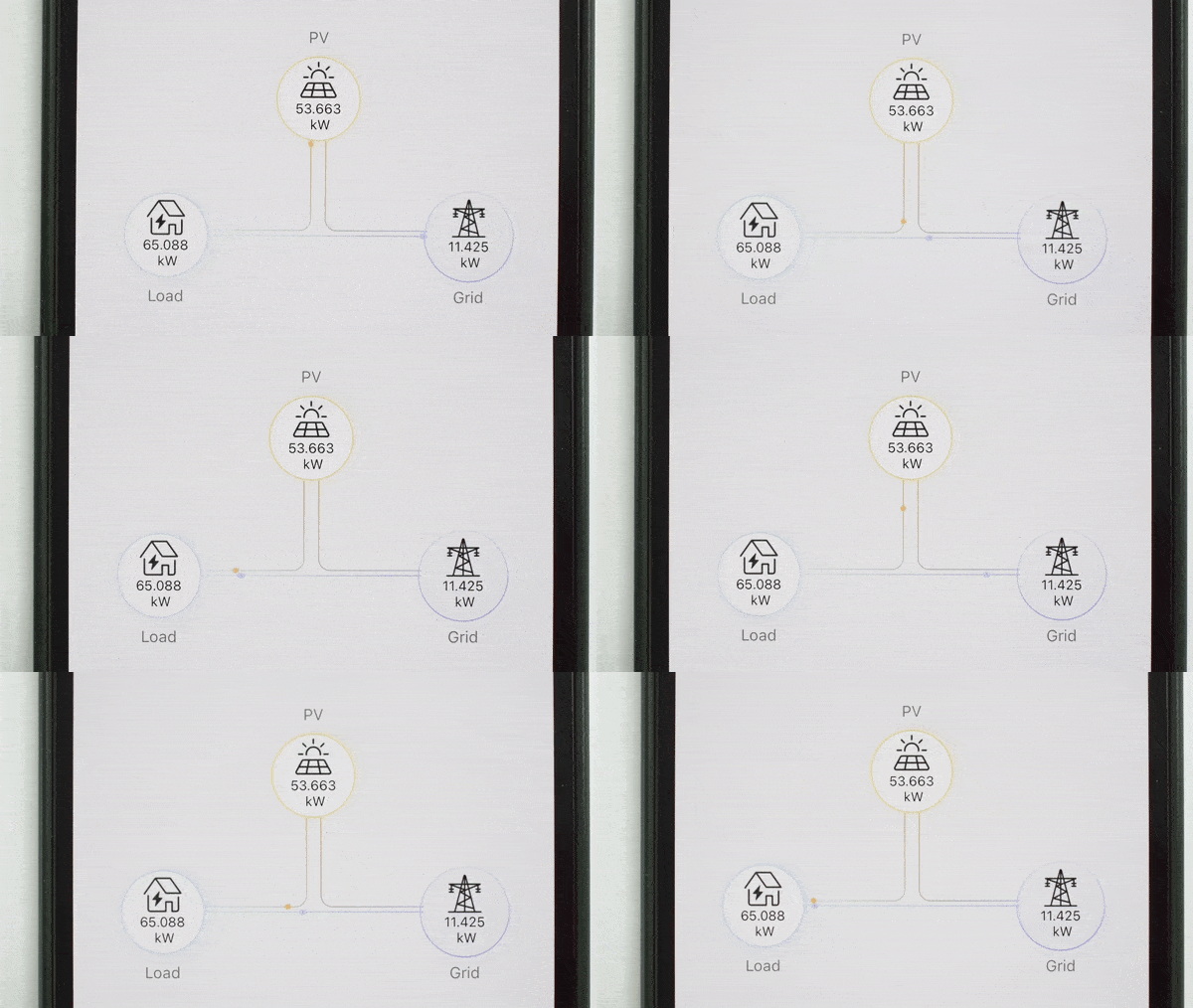
On a cloudy September day, we still manage to draw most of the electricity from solar panels.
GRS/GOTS-Certified Yarns
We buy all our 100% recycled polyester yarns from a UK-based company Martin Bunzl. You can find them in the Textile Exchange’s database of certified suppliers by entering “Martin Bunzl” under the Certified Organisation Name tab.

We buy organic cotton yarns with GOTS certificates from a reputable Turkish company UZ Pamuk AS. Here is their official GOTS-certified supplier profile.
Being that we are also GOTS and GRS-certified, you are guaranteed to get labels and hang tags with your orders for organic cotton and/or recycled polyester clothing.
The sustainable garment factory in Belgrade
The Belgrade factory buzzword is upcycling. This is where we achieve that extra step as sustainable clothing manufacturers. In fact, we have started our own clothing brand that sells upcycled clothing made from deadstock fabrics. Of course, it too has only LED lighting throughout the production area.
As we do most of the fabric cutting here, we create a lot of potential textile waste. So, instead of going straight into the landfill, all our “textile extras” end up in two places:
NURDOR
NURDOR is a national association of parents of children battling cancer. Its members are parents, doctors, medical staff, legal advisors, and volunteers.
Our trimmings are a regular part of NURDOR’s Love and Hope camps – events where mums get to express themselves through art. Mums use our textile cut-offs to make lovely handcrafted goodies like necklaces and wristbands. It is a small contribution, but because it is for a great cause, it is one that is very dear.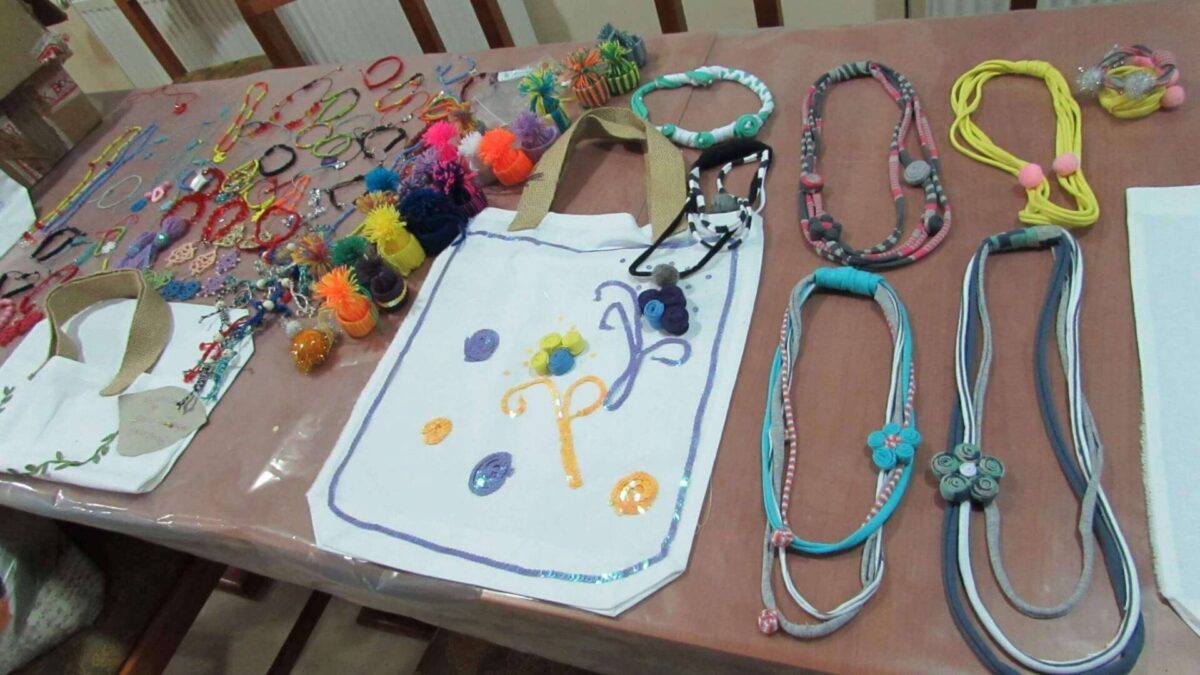
Necklaces and wristbands made at the NURDOR Love and Hope camp. FUSH˚ fabric trimmings are the material that was used to make these works of art.
Iron Sport
Iron Sport is a Serbian sporting equipment manufacturer – an expert in making boxing gear.
And they need a constant supply of our textile cut-offs in order to make fillings for their boxing bags. In fact, we can make a lot more “textile extras”, and Iron Sport would still upcycle them in no time. Thanks for helping us maintain our sustainable clothing manufacturer status, Iron Sport!
Visit our clothing factories
We believe that the best way to ensure a clothing manufacturer does its business sustainably is to see it for yourself.
That is why we encourage both existing and potential clients to visit us. In fact, we have built the apartments right on the factory grounds in Oraovica to facilitate the visits.
Below is a contact form where you can ask us anything we didn’t answer on this page. Keep in mind that the more detailed the enquiry makes the more precise price and lead time estimate.
FAQ
How do you know if a supplier is sustainable?
There are three key sustainable features of a clothing manufacturer:
- They’re certified
- You can visit them anytime
- They’re helping their community
The easiest thing is to go through their certifications. The most sustainable manufacturers would have any of the following:
- GOTS (Global Organic Textile Standard)
- BCI (Better Cotton)
- RWS (Responsible Wool Standard)
- GRS (Global Recycled Standard)
- OEKOTEX100
- Bluesign
- ISO 14001:2015
- SA8000
Each of these certificates guarantees that the supplier CAN manufacture clothes sustainably. Whether they do is a thing of inspection. Having said that, a sustainable manufacturer must allow you to visit them with little to no prior notice. That way, you can know whether or not they’re continuing the practices that have earned them their certificates.
Additionally, a truly sustainable business would do whatever it can to improve its community. Ask your potential supplier about their community projects.
What is sustainable fashion manufacturing?
It’s a type of fashion manufacturing that:
- Ensures that the clothing factory workers have a healthy and safe working environment
- The clothing factory compensates its workers enough for them to lead a dignified life
- Working hours are within legal limits
- No toxic chemicals are used in any stage of production (especially during dyeing)
- Materials that the factory uses are vegan, natural and/or organic
- Water is used sparingly and in a closed-loop system
- Renewable energy is the main energy source for the factory
Request a quote from us
To get the best possible price and lead time estimate, please include the number of designs and pieces per design, fabric choice, sizes, and printing options.
- FUSH˚ Addresses:
- Velizara Stankovića 67
Belgrade, Serbia (view in Google Maps) - Oraovačka BB
Oraovica, Serbia (view in Google Maps)
- Velizara Stankovića 67
- Phone: +381 11 359 10 48
- Email: info@fush.rs